
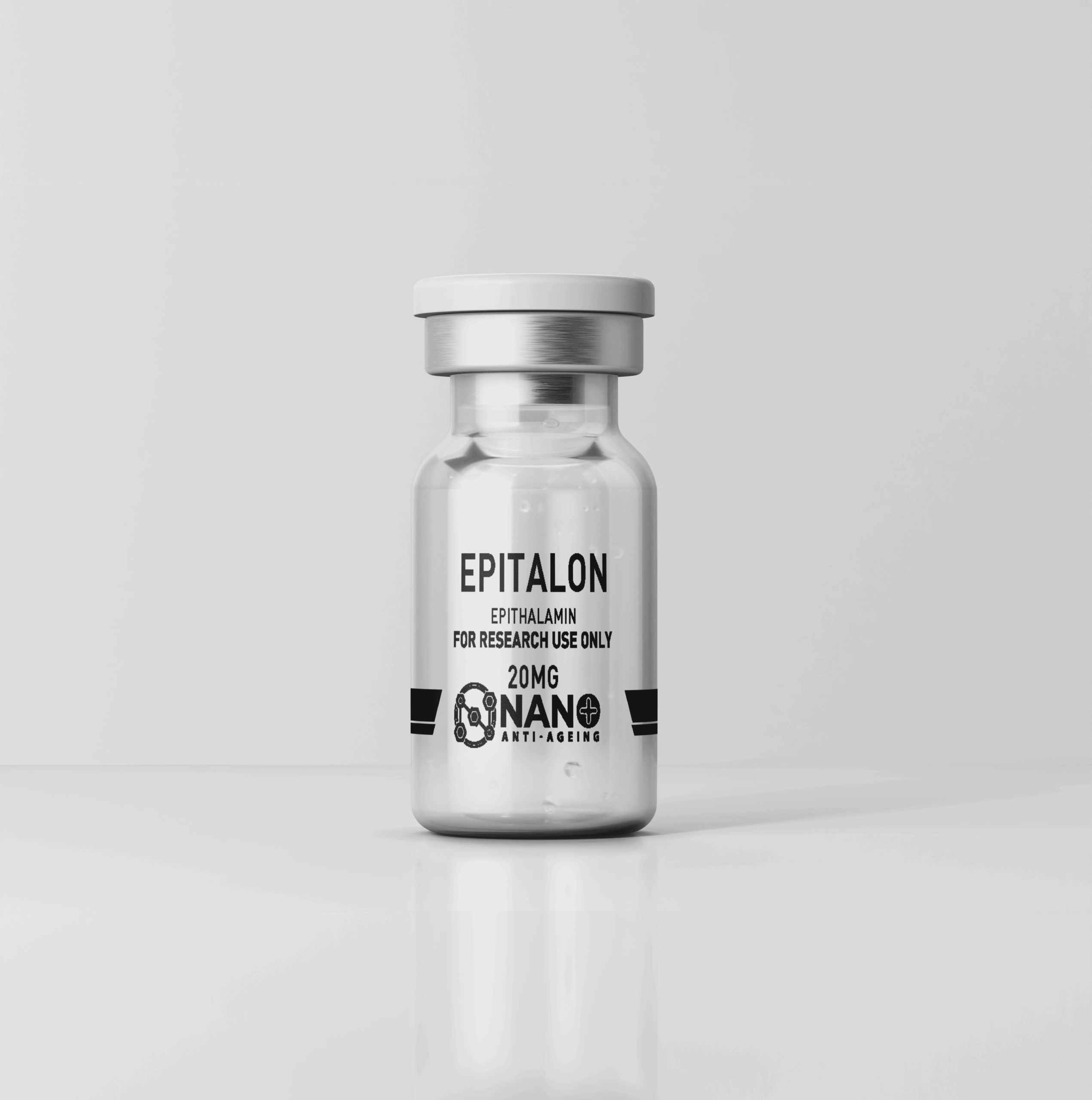
Epitalon, also known as Epithalon, is a synthetic tetrapeptide with the sequence Ala-Glu-Asp-Gly (AEDG), originally developed based on the amino acid composition of Epithalamin, a polypeptide derived from the bovine pineal gland. It has been studied extensively for over 25 years, particularly regarding its potential effects on aging and cellular senescence. Research indicates that Epitalon may exhibit geroprotective properties, predominantly through its ability to modulate telomerase activity and influence telomere length, though more evidence is required to fully establish these claims (Araj et al., 2025).
A critical mechanism by which Epitalon may exert its effects is through the upregulation of telomerase, an enzyme essential for maintaining telomere length, which typically shortens with each division of a cell. Studies have demonstrated that restoration of telomerase activity can elongate short telomeres, thereby reducing chromosomal instability and mitigating symptoms associated with premature aging (Samper et al., 2001). Additionally, higher telomerase activity is correlated with improved cellular replication capacity and reduced senescence, particularly in stem cell populations (Cheung et al., 2014; . There is also some evidence suggesting that Epitalon may enhance antioxidant defenses, potentially decreasing oxidative stress that contributes to telomere shortening (Lateef et al., 2022).
Moreover, recent findings suggest that Epitalon might influence epigenetic regulation, possibly by binding to histones, which indicates a multifaceted role in gene regulation related to aging processes (Al-Dulaimi et al., 2025). The potential of Epitalon to increase telomere length may offer a protective mechanism against genetic instability often associated with aging while potentially mitigating the impacts of environmental stresses that contribute to telomere attrition (Muralidharan et al., 2022).
Epitalon’s implications for telomere and telomerase dynamics suggest broader significance in not only aging but also in various diseases where telomere dysfunction is a notable factor. Conditions related to critically short telomeres may theoretically see benefits from the modulation of telomerase activity that Epitalon may provide (Cheung et al., 2014; Allsopp et al., 1992). This highlights its potential therapeutic applications and underscores the importance of understanding telomere dynamics in relation to human health and longevity.
In conclusion, Epitalon appears to play a significant role in regulating telomerase activity and telomere maintenance, presenting promising directions for future research focused on aging and related health issues. Ongoing investigation into its mechanisms and effects will further clarify its role in cellular biology and prospective therapeutic applications.
References:
Al-Dulaimi, S., Thomas, R., Matta, S., & Roberts, T. (2025). Epitalon increases telomere length in human cell lines through telomerase upregulation or alt activity.. https://doi.org/10.21203/rs.3.rs-7066545/v1
Allsopp, R., Vaziri, H., Patterson, C., Goldstein, S., Younglai, E., Futcher, A., … & Harley, C. (1992). Telomere length predicts replicative capacity of human fibroblasts.. Proceedings of the National Academy of Sciences, 89(21), 10114-10118. https://doi.org/10.1073/pnas.89.21.10114
Araj, S., Brzezik, J., Mądra-Gackowska, K., & Szeleszczuk, Ł. (2025). Overview of epitalon—highly bioactive pineal tetrapeptide with promising properties. International Journal of Molecular Sciences, 26(6), 2691. https://doi.org/10.3390/ijms26062691
Cheung, H., Liu, X., Canterel-Thouennon, L., Li, L., Edmonson, C., & Rennert, O. (2014). Telomerase protects werner syndrome lineage-specific stem cells from premature aging. Stem Cell Reports, 2(4), 534-546. https://doi.org/10.1016/j.stemcr.2014.02.006
Lateef, H., Suresh, P., Bharathi, P., Pathak, S., & Banerjee, A. (2022). A brief overview of telomeres and telomerase in aging and cancer. Current Applied Science and Technology, 23(4). https://doi.org/10.55003/cast.2023.04.23.015
Muralidharan, A., Sotocinal, S., Yousefpour, N., Akkurt, N., Lima, L., Tansley, S., … & Mogil, J. (2022). Long-term male-specific chronic pain via telomere- and p53‑mediated spinal cord cellular senescence. Journal of Clinical Investigation, 132(8). https://doi.org/10.1172/jci151817
Samper, E., Flores, J., & Blasco, M. (2001). Restoration of telomerase activity rescues chromosomal instability and premature aging in terc−/− mice with short telomeres. Embo Reports, 2(9), 800-807. https://doi.org/10.1093/embo-reports/kve174






Reviews
There are no reviews yet.