
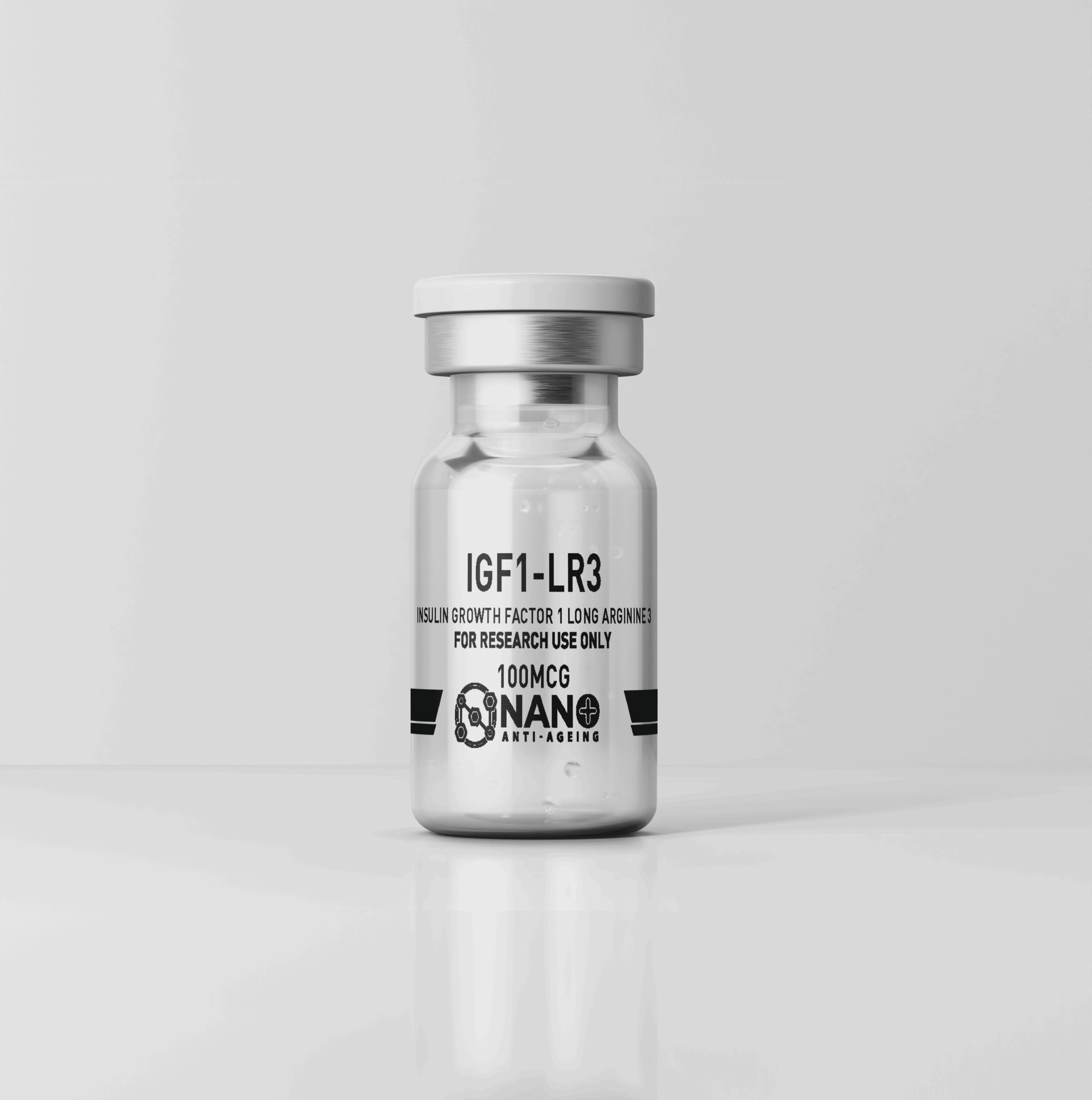
Insulin-like Growth Factor 1 Long Arg3, commonly known as IGF-1 LR3, is a synthetic analog of the natural peptide IGF-1. This analog has a longer half-life than its parent compound due to a substitution of the amino acid at the third position; specifically, the normal glutamic acid in IGF-1 is replaced by arginine (arginine in position 3 (R3)). This substitution significantly prolongs its activity and stability within biological systems, which enhances its anabolic effects on tissues such as skeletal muscle and cartilage (Imanova & Mammadov, 2024).
The mechanism of IGF-1 LR3 involves binding to the IGF-1 receptor (IGF-1R), initiating a series of downstream signaling pathways that promote cell proliferation and inhibit apoptosis, which are crucial roles in growth and development processes. This interaction is significantly influenced by insulin-like growth factor binding proteins (IGFBPs), which modulate IGF action in circulation (Imanova & Mammadov, 2024). Notably, IGF-1 LR3’s resistance to proteolytic degradation by IGFBPs positions it as a compound of interest in various therapeutic research domains, particularly for muscle-wasting diseases and post-injury recovery (Niederkofler et al., 2013).
Research has demonstrated that IGF-1 signaling is linked with tumorigenesis. Elevated levels of IGF-1 can upregulate cellular pathways frequently activated in various cancers through IGF-1R signaling, leading to increased cell survival and proliferation. Understanding the balance and regulation of IGF-1, IGFBPs, and their receptors is essential for addressing conditions associated with inappropriate cellular proliferation (Suman et al., 2014; , Haley et al., 2010).
Moreover, IGF-1 LR3 has been investigated in the context of its potential applications in sports and muscle recovery due to its anabolic properties, including its capacity to stimulate protein synthesis and enhance muscle recovery post-exercise (Imanova & Mammadov, 2024). Its role in the PI3K/Akt signaling pathway suggests that IGF-1 LR3 may improve muscular endurance and athletic performance (Zeng et al., 2011).
Additionally, studies have focused on the implications of IGF-1 LR3 in managing metabolic disorders, underscoring its relevance in the discourse surrounding growth factors and their impact on health and disease management (Holmes et al., 2012).
In summary, IGF-1 LR3 represents a critical component in understanding both normal physiological growth and pathological states characterized by uncontrolled cell proliferation, offering intriguing avenues for future research on its therapeutic potentials.
References:
Haley, J., Thomson, S., Bean, J., Xie, R., Epstein, D., Miglarese, M., … & Buck, L. (2010). Abstract sy01-01: adaptive protein and phosphoprotein networks which promote therapeutic sensitivity or acquired resistance. Cancer Research, 70(8_Supplement), SY01-01-SY01-01. https://doi.org/10.1158/1538-7445.am10-sy01-01
Holmes, K., Annala, M., Chua, C., Dunlap, S., Liu, Y., Hugen, N., … & Zhang, W. (2012). Insulin-like growth factor-binding protein 2-driven glioma progression is prevented by blocking a clinically significant integrin, integrin-linked kinase, and nf-κb network. Proceedings of the National Academy of Sciences, 109(9), 3475-3480. https://doi.org/10.1073/pnas.1120375109
Imanova, P. and Mammadov, A. (2024). The role of insulin-like growth factor 1 (igf-1) in different biological processes and in sports. Institute of Molecular Biology & Biotechnologies Transactions, 8(2), 49-59. https://doi.org/10.62088/timbb/8.2.8
Niederkofler, E., Phillips, D., Krastins, B., Kulasingam, V., Kiernan, U., Tubbs, K., … & Nedelkov, D. (2013). Targeted selected reaction monitoring mass spectrometric immunoassay for insulin-like growth factor 1. Plos One, 8(11), e81125. https://doi.org/10.1371/journal.pone.0081125
Suman, S., Fornace, A., & Datta, K. (2014). Abstract 2505: exposure to a therapeutically relevant dose of ionizing radiation reveals colorectal cancer biomarker and associated receptor alterations. Cancer Research, 74(19_Supplement), 2505-2505. https://doi.org/10.1158/1538-7445.am2014-2505
Zeng, X., Zhang, H., Oh, A., Zhang, Y., & Yee, D. (2011). Enhancement of doxorubicin cytotoxicity of human cancer cells by tyrosine kinase inhibition of insulin receptor and type i igf receptor. Breast Cancer Research and Treatment, 133(1), 117-126. https://doi.org/10.1007/s10549-011-1713-x



Reviews
There are no reviews yet.